
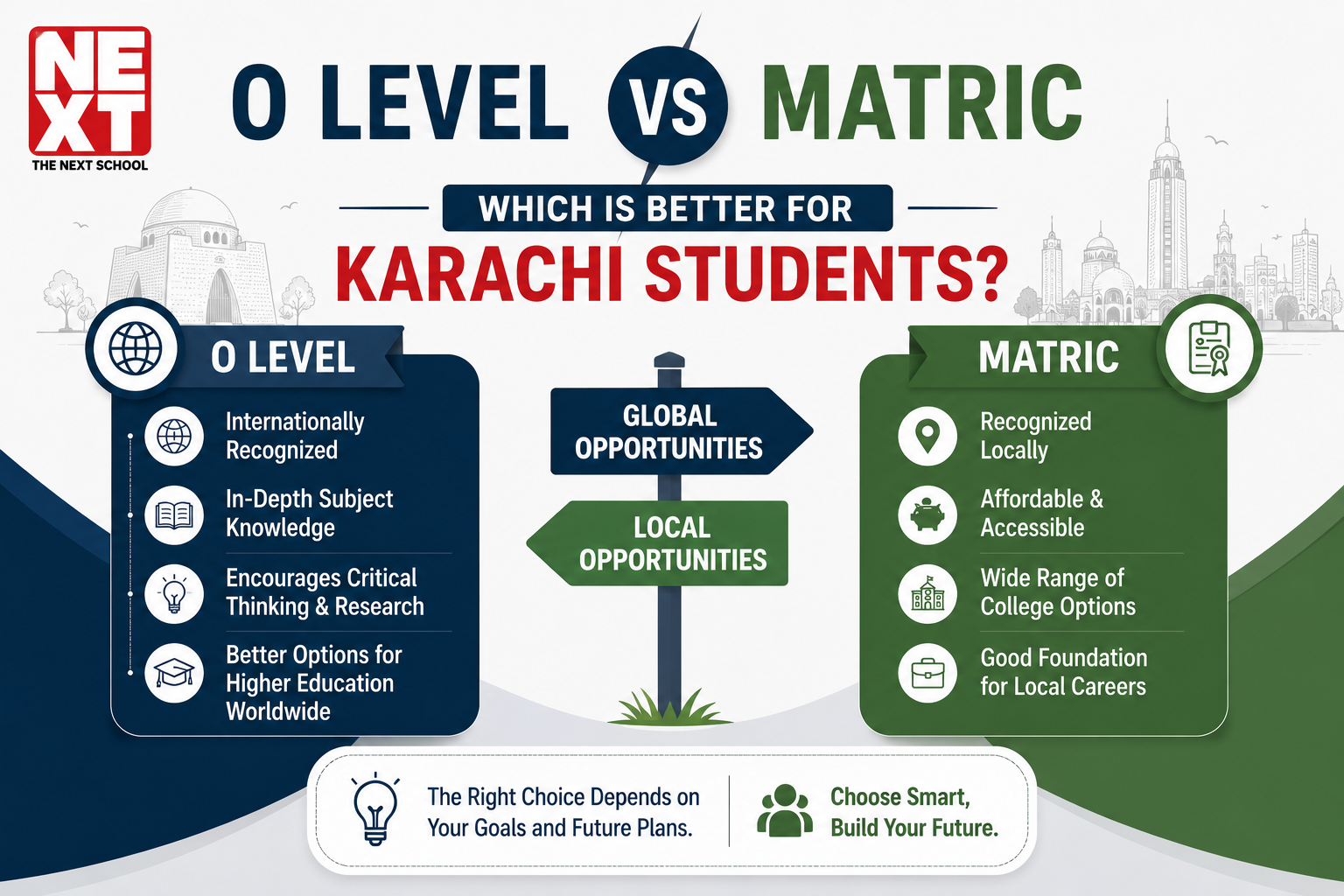
O Level vs Matric: Which Is Better for Karachi Students?
If you’ve got a kid heading into grade 9, you’ve probably already had this conversation at the dinner table. O Level or Matric.Everyone in Karachi seems to have an opinion, your neighbor, your child’s tuition teacher, that one cousin who studied abroad. But most of these opinions are based on one experience, not the full picture.
So let’s actually go through it properly. What is each system, how are they different in practice, and how does that play out for families here in Karachi.
Matric, the system most of us grew up knowing
Matric is short for Matriculation. It’s the certificate you get after grade 9 and 10 through a local board, in our case that’s BISE Karachi. The syllabus comes from the Sindh Textbook Board, and it’s the route that most schools in the city, government and private both, have followed for generations.
There’s nothing complicated about it. You study the prescribed books, you sit one big exam at the end of the year, and your result comes from the board. Simple, predictable, and available literally everywhere, from a small school in Korangi to a big name in Clifton.
O Level, the Cambridge route
O Level comes from the UK’s Cambridge Assessment International Education. Instead of one fixed exam covering everything, students pick individual subjects and get graded per subject by Cambridge itself, not a local board.
Schools offering O Level in Karachi are usually English-medium, and the teaching style leans more toward “explain this concept” rather than “memorize this paragraph.” A lot of parents who plan to send their kids abroad later go this route because it lines up better with how foreign universities evaluate applicants.
Where the two actually differ
How they teach
Matric rewards students who can reproduce what’s in the textbook accurately. O Level rewards students who can explain and apply what they’ve learned, even if it’s phrased differently than the textbook. Neither approach is wrong, it just suits different kinds of learners. A child who’s strong at memorizing and disciplined about revision might do great in Matric. A child who asks a lot of “why” questions might thrive more in O Level classrooms.
Subject choice
This one’s underrated. In Matric, you’re basically locked into a group, Science, Arts, Computer Science, whatever your school offers. In O Level, students often mix and match subjects based on what they’re actually good at or interested in. Want to drop Biology and pick up Business Studies instead? Much easier under Cambridge.
The money question
Let’s be honest, this is usually the deciding factor for most families. O Level schools in Karachi charge significantly more, and on top of tuition, you’re paying Cambridge registration and exam fees in dollars, which adds up fast given the exchange rate. Matric, especially in government schools or mid-range private schools, is far lighter on the pocket. For a lot of households, this alone settles the debate before curriculum even comes into it.
Recognition, locally and internationally
Matric is fully recognized everywhere within Pakistan, no extra paperwork needed for local university admissions or government jobs. O Level is recognized internationally, which matters a lot if university abroad is the plan. But here’s something people often forget, O Level students still need to get an equivalence certificate from IBCC before applying to most Pakistani universities. So it’s not entirely paperwork-free even locally.
Exams
Matric has one shot a year through the board. O Level gives a bit more breathing room, some subjects can be attempted in different exam sessions, and a few even include coursework components instead of relying purely on a final paper.
What Karachi actually looks like on the ground
You’ll find O Level schools concentrated mostly around DHA, Clifton, and parts of Gulshan, and yes, the fee structure reflects the area. Matric schools are spread more evenly across the city, there are solid, affordable options in North Nazimabad, Gulistan-e-Johar, and plenty of other neighborhoods.
If you’re comparing specific schools, don’t just go by name recognition. Look at actual result trends, talk to a few current parents, and if possible, sit in on a class or two before enrolling. Reputation only tells you part of the story.
So which one should you actually pick?
Honestly? It depends on what you’re planning for your child five or ten years down the line, not on which system sounds more impressive at a dinner party.
Go with O Level if you’re seriously considering university abroad, want a more discussion-based classroom environment, and the extra cost isn’t going to strain the household budget every month.
Go with Matric if affordability matters, you’re planning on local university admissions or government-sector jobs, and you’d rather stick with a system that’s been tried and tested for decades.
Plenty of successful, capable people in Pakistan came out of both systems. The certificate on paper matters less than whether your child is actually engaged in the classroom, has decent teachers, and is being pushed to think rather than just memorize and forget.
Bottom line
There’s no universal winner here between O Level and Matric. It’s really a question of your family’s budget, your child’s learning style, and where you see them studying after grade 10. Karachi has strong schools on both sides of this debate, so take the time to visit a few, ask current parents honest questions, and make the call based on what actually fits your situation, not what sounds better in conversation.
Whatever you choose, the real difference gets made by good teachers and a genuinely supportive school environment, not the name of the exam board on the certificate.